

Assessment of performance and uncertainty in qualitative chemical analysis


- Details
- Category: Guides
- Last Updated: Sunday, 15 March 2026 23:45
Introduction
 Many decisions with socio-economic or individual impact depend on qualitative analysis, including decisions related to food safety, clinical diagnosis, and forensic evidence, are based primarily on qualitative, rather than quantitative, chemical analysis. Qualitative analysis is analysis that returns a classification rather than a numerical value, such as the identity of a chemical substance, the type of plastic of a microparticle, the potential source of an oil spill, the presence of a banned sports doping substance, or the presence of accelerant in fire debris. Sometimes, such classifications rely solely on qualitative tests; others may use measurement results (such as line frequencies in a spectrum) to reach a conclusion.
Qualitative analysis, like quantitative analysis, needs to be demonstrably reliable. Part of the purpose of the guide is accordingly to show how the performance of a qualitative analysis procedure can be quantified to ensure its fitness for purpose. Practical difficulties and limitations in reliable quantification of low false result rates are discussed, and recommendations are made for checking the validity of these analyses. Brief recommendations are also made for ensuring that any measurements undertaken in the course of a qualitative analysis are reliable.
Although laboratories accredited following the ISO/IEC 17025 standard are not currently required to express qualitative analysis results with uncertainty, the guide provides some metrics that can be used to convey the level of confidence in conclusions from qualitative analysis. In addition, the guide provides suggestions for reporting results with an indication of confidence if desired.
This guide does not make recommendations on whether or not laboratories should routinely report information on the confidence, or uncertainty, associated with qualitative analysis results. Nevertheless, an understanding of performance, or of the uncertainty associated with a qualitative analysis result, can help laboratories to better advise customers; it can also help to identify quality improvements or determine (for example) whether additional confirmatory tests might be needed.
This Eurachem/CITAC guide accordingly aims to provide some tools to help improve the quality of qualitative analysis and of their interpretation, to make sure that interests dependent on these analyses are well protected.
Content of the guide
This guide includes information on
- The nature and relevance of qualitative analysis.
- Different types of qualitative analysis - for example, those that depend on qualitative tests alone, and others that use quantitative information to come to a conclusion.
- Experimental and other strategies for estimating false response rates, which are fundamental to establishing reliability.
- Expressions of confidence in qualitative analysis.
- Reporting qualitative analysis results.
- Examples showing how false response rates and other metrics can be determined.
- The statistical basis for some important measures of confidence in a qualitative result.
Availability
The guide may be downloaded from this website at no cost.
- Download the Guide in Czech (PDF, 1.4 Mb) (Published 2022-12-20)
- Download the Guide in English (PDF, 1.8 Mb) (Published* 2021-11-17)
- Download the Guide in Farsi (PDF, 2.3 Mb) (Published 2024-04-04)
- Download the Guide in German (PDF, 1.4 Mb) (Published 2024-04-04)
- Download the Guide in Russian (PDF, 2.6 Mb) (Published 2024-06-18)
* First published 2021-11-11. Publication dates above are dates of file publication on this website.
Translation
Translation into other languages is permitted for members of Eurachem. Other offers of translation should be directed to the Eurachem Secretariat for permission. The Eurachem policy on maintenance and development of Eurachem guidance, available on the Policies page, gives further information on translation.
Citation
This guidance should be cited* as
"R Bettencourt da Silva and S L R Ellison (eds.) Eurachem/CITAC Guide: Assessment of performance and uncertainty in qualitative chemical analysis. First Edition, Eurachem (2021). ISBN 978-0-948926-39-6.
Available from www.eurachem.org."
*Subject to journal requirements.
Previous editions
There are no earlier editions of this Guide.
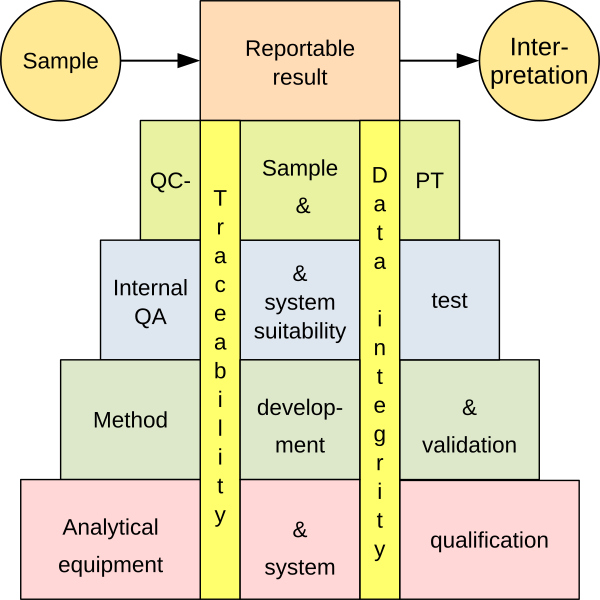 A wide variety of analytical equipment is used in analytical laboratories, ranging from simple apparatus to complex computer-based systems, to collect data that helps to obtain a reportable result. Many of these pieces of equipment combine a measurement function with software control. There are many ways to demonstrate that an equipment is qualified and under control, including qualification, calibration, validation and maintenance. To ensure ‘fitness for purpose’, an integrated approach based on risk assessment is recommended.
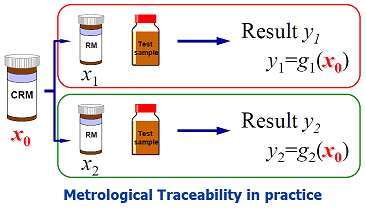 This Guide gives detailed guidance for the establishment of metrological traceability in quantitative chemical analysis, based on the definition in the international vocabulary of basic and general terms in metrology (VIM). Though it is aimed principally at testing and measurement laboratories carrying out chemical measurement, the principles are expected to apply from routine analysis to basic research. The document is intended to assist laboratories in meeting the requirements on traceability of results given in ISO/IEC 17025.